
Your Cart is Empty
Window furnishings ⌄
- ABOUT
- In Studio
- Gallery
- Contact Us
- Shop
- +612 9960 2844
- Login


You like your mattress. The bed base is still in good condition. But the bedroom feels unfinished, or the old bedhead no longer suits the room. Do you need to replace the whole bed to change the look?
In some cases, you can keep your existing base and introduce a new upholstered bedhead. The answer depends on the base, the bedhead design, how it will be supported and the space around it. A familiar size label, such as queen or king, is only the starting point.
For homeowners exploring custom bedheads in Sydney, checking those practical details early makes the design conversation much more useful. It helps you decide whether you want a simple backdrop to your bedding, a taller upholstered feature or a wider design that includes the bedside tables.
At Tempo Interiors, we help Sydney clients explore custom beds and bedheads, with fabric selections available through our Mosman studio. You can enquire about a bedhead on its own. Whether a particular option will work with the base you already own needs to be checked against the selected design.
Here is what to consider before choosing the shape or falling in love with a fabric.
Write down what you have and what you intend to retain. Is it an ensemble base beneath a separate mattress? A timber or metal frame with slats? A storage bed? Does the current bedhead form part of that frame, or is it a separate piece?
Photograph the whole bed, then take a closer photograph of the connection between the existing headboard and base, if it is safely visible. Keep the make and model details if you have them. Instructions or a product specification can be more useful than trying to identify a fixing from a photograph alone.
A decorative panel that can be removed is a different starting point from a bedhead that helps hold the frame together. Do not dismantle or alter the bed simply to see whether a new design might fit. Ask the supplier to confirm what can be changed without affecting the existing structure.
If the base is damaged or no longer suits your needs, address that before planning a new upholstered feature around it. Likewise, mention any intended mattress change. A deeper replacement mattress could leave less of the bedhead visible than you expected.
The aim is to make a clear decision about what stays, rather than assume that everything must be replaced or that everything can be retained.
Separate bedheads may be designed to attach to a compatible base, mount to a suitable wall or stand on their own supporting structure. These are different arrangements, and their availability depends on the product.
For a base-mounted option, the relevant question is whether the bedhead and base have compatible construction and fixing positions. Matching their size names does not settle that question.
For a wall-mounted option, the wall construction, bedhead weight and specified fixing method need assessment. Where permission is relevant, such as in a rental property, establish that before selecting a design that requires wall fixings.
A freestanding design also needs to be used as intended. Do not assume that any upholstered panel can safely be propped behind a bed. Ask how the particular design is supported, positioned and installed.
Tempo can discuss your proposed arrangement as part of exploring suitable options. Confirm the installation requirements for the selected design before ordering, rather than treating fixing as something to resolve when the bedhead arrives.
Record the actual width and length of your mattress, then measure the outside dimensions of the base or frame separately. An upholstered surround can extend beyond the mattress. A winged bedhead can also have a different outer width from the central panel you see behind the pillows.
Use millimetres throughout your notes, and label each dimension. “Bed width” is ambiguous if one person means the mattress and another means the full frame.
It is worth noting whether the base is one piece or split, whether there are storage drawers and where they open. If you have an adjustable bed, raise that at the outset so its movement and manufacturer requirements can be considered.
These initial measurements support the discussion. They should not be treated as final production dimensions until the supplier has confirmed what needs measuring and who is responsible for the final check.
There is no single width that works for every bedroom. Start by deciding what the bedhead should relate to: the bed alone, the bed and its bedside tables, or a larger section of the wall.
A design close to the bed's overall width can keep the arrangement contained. A little extra width may give the bedding room within the outline. An extended bedhead can create a continuous backdrop behind bedside furniture, but it also brings more of the wall into the design.
Sketch the bed, both tables and the proposed bedhead from the front. Include windows, wall lights and sockets. If one side of the room is different from the other, draw that difference rather than producing an artificially symmetrical plan.
Compare a narrower and wider version before deciding. Ask what happens at each end. Does the bedhead finish awkwardly beside a window? Would a lamp sit in front of it or beyond it? Can you still reach a switch comfortably?
The most convincing width is one that works with the arrangement you actually have. Extending to the wall's edges is an option to assess, not an automatic improvement.
A bedhead's overall height and the portion visible above the mattress are different measurements. Confusing them can produce a result that looks much shorter or taller than intended.
Measure from the floor to the top of the mattress. Then consider where you want the top of the bedhead to finish. Look at the bed with your usual pillows in place, not only with bare bedding removed.
If you like a shaped top, think about how much of that outline the pillows would cover. If you want a quieter rectangular backdrop, you may prefer a different balance. A high mattress and a low mattress can change the appearance of the same bedhead considerably.
Check the relationship with artwork, windowsills and wall lighting too. A room photograph taken straight on can help you compare the proposed top edge with these features. Confirm whether the quoted height describes the complete installed piece, the upholstered panel or another reference point.
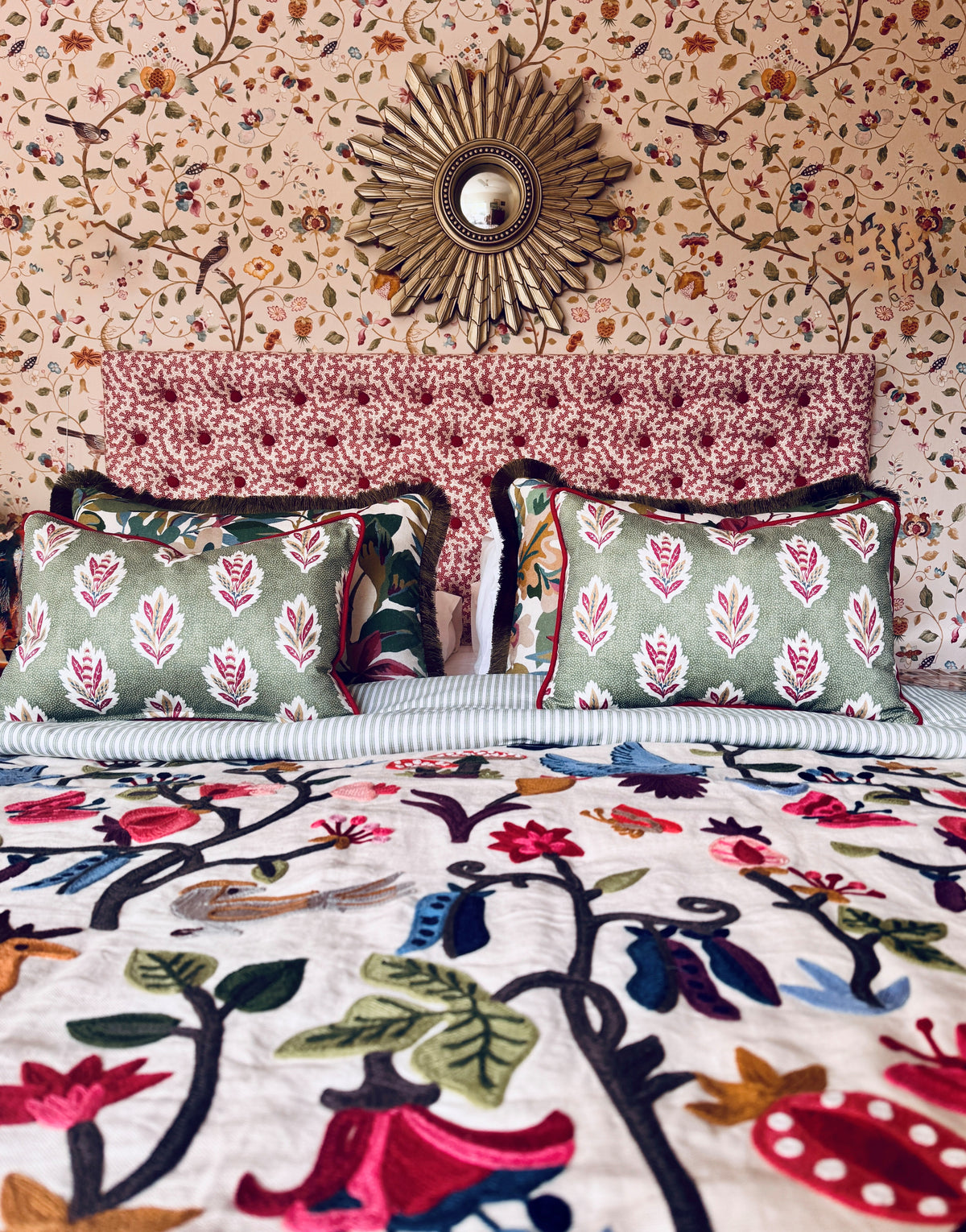
A bedhead occupies space behind the bed, even when it looks slim from the front. Its finished depth, supporting arrangement and clearance from the wall can affect where the base sits.
Ask for the intended installed position, then check the space at the foot of the bed. Make sure you can still use nearby drawers, doors and wardrobes in the way you need to. Look at the room with those doors open, rather than judging it only when everything is closed.
Deep upholstery, wings and projecting details deserve attention from the side as well as the front. A side-view sketch is useful here. Show the wall, skirting, bedhead, base and mattress so that everyone is discussing the same arrangement.
Record the height of the skirting and how far it projects from the wall. This can matter where a bedhead or its supporting parts need to sit close to that wall. Any allowance must be considered within the selected construction, not improvised afterwards.
Photograph sockets and switches near the bed. Note their position relative to a fixed reference, such as the corner of the room, and include nearby lights. A wide bedhead may extend into areas previously left exposed.
Check where plugs and leads would go and whether the fittings remain accessible. Do not plan to trap wiring behind upholstery or assume that a cut-out can be added to any design. Discuss possible conflicts before the specification is finalised, with electrical work assessed by an appropriately qualified professional where needed.
Consider an imaginary bedroom with a clear bed wall measuring 3,600 mm wide. The existing base is 1,900 mm wide, the mattress top sits 620 mm above the floor and the owner wants to keep two bedside tables, each 500 mm wide.
They are considering a bedhead 2,100 mm wide, with the tables positioned outside its edges. Allowing a proposed 50 mm gap between each table and the bedhead gives a total arrangement of 3,200 mm: the 2,100 mm bedhead, two 500 mm tables and two 50 mm gaps.
That leaves 400 mm across the wall, or 200 mm at each end if everything is centred. This is only a width calculation. It does not prove that the layout is comfortable or that doors, curtains, sockets and access will work.
For height, suppose the owner is considering an installed top edge 1,350 mm above the floor. With the mattress top at 620 mm, 730 mm would remain above the mattress before allowing for pillows.
Those figures are illustrative, not recommended dimensions or a Tempo project. The value of the exercise is that it reveals the relationships. The owner can compare another width or top-edge height before requesting a detailed specification.
Once you have a possible outline, view it from the bedroom doorway and from beside the bed. A simple drawing placed over a straight-on room photograph can help. If marking an outline on the wall, use a method suitable for the surface that will not damage its finish.
Leave the bedside furniture and everyday bedding in place while comparing options. Include the lamps you intend to keep. This gives a more useful impression than an empty wall, especially when the room is not symmetrical.
Consider the practical habits that happen around the bed. Where do you put a book or glasses? Can you reach the light from your usual position? Does the proposed outline leave the artwork feeling crowded? These questions can help you choose between two designs that both fit on paper.
Once the likely proportions are clearer, look at fabric alongside the elements staying in the room. Bring photographs of the bedding, flooring, curtains and bedside tables, as well as any samples you already have.
A large upholstered surface can carry a stronger presence than a small swatch suggests. Think about whether you want the bedhead to be the main feature or a quieter part of the room. A patterned design might lead the palette; a plain fabric could leave more room for changing bedding and accessories.
Ask about upholstery suitability, cleaning requirements and how the chosen fabric would be arranged across the proposed shape. Where relevant, discuss joins and pattern placement before approving the final design. The appearance of a wide panel may depend on more than the colour you choose.
If the existing base remains visible, consider whether it needs to match at all. A complementary finish may suit the room. A coordinating cover or valance may be worth discussing where appropriate, but should not interfere with storage or the base's operation.
Our guide to choosing upholstery fabric can help you prepare questions about use, care and coordination.
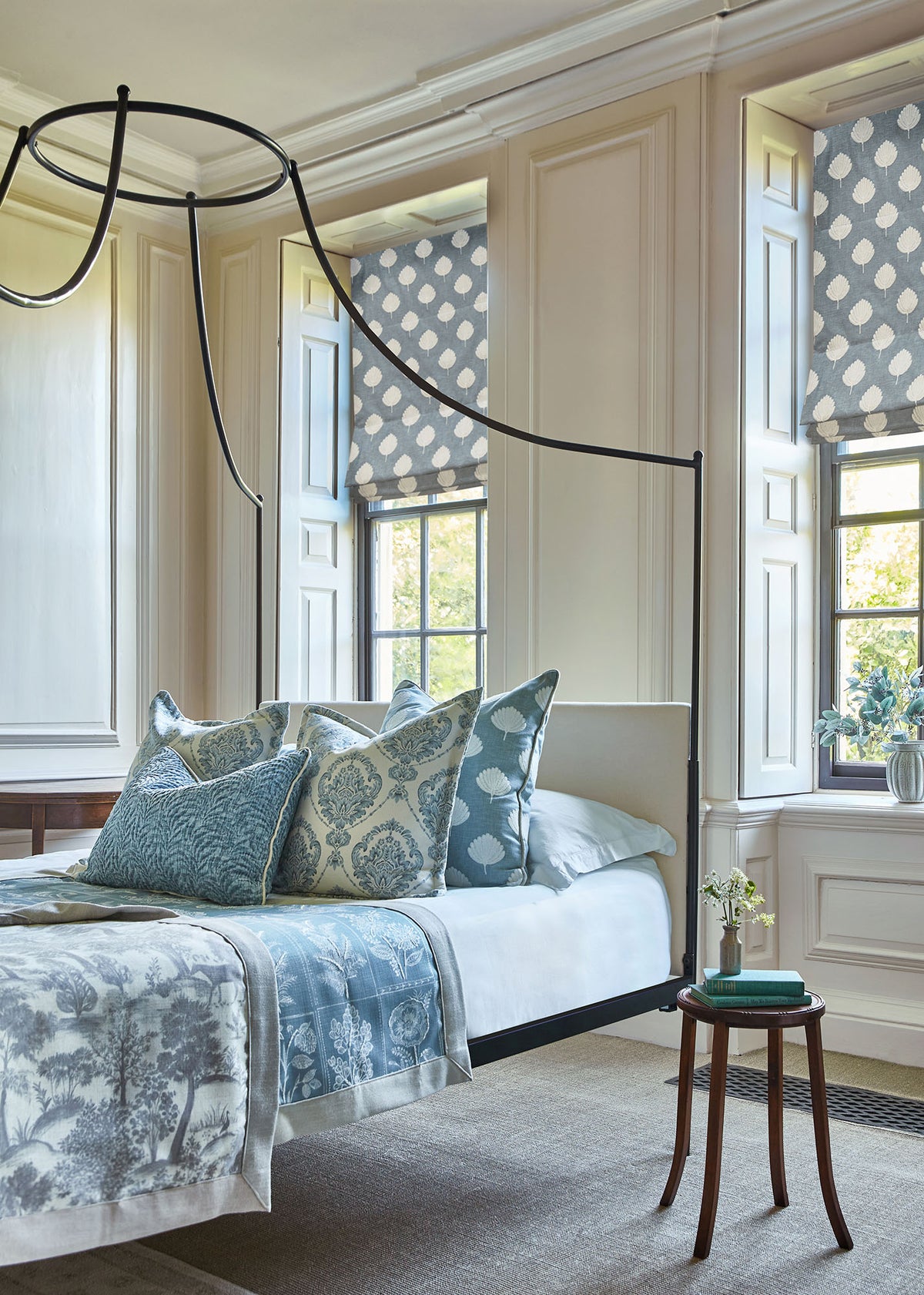
A bedhead can fit the intended wall and still be difficult to get into the room. Look at the entire delivery route, including the building entrance, stairs, lift, landing and bedroom doorway.
Photograph narrow points and tight turns. Where a lift is involved, ask what dimensions the delivery team needs. Check any building booking requirements before agreeing to a delivery arrangement.
Do not assume a large bedhead will arrive in sections or can be taken apart. Confirm its delivery form, packaging considerations and any installation arrangements with the supplier. If access is restricted, raise it before the design is ordered.
You do not need a finished design. A clear starting brief is more useful than a long collection of unrelated inspiration images.
Prepare:
Mark approximate measurements as approximate. The next step is to establish which details need further checking, not turn an informal sketch straight into an order.
Ask for clarity on the finished dimensions, the selected fabric and the proposed support or fixing arrangement. Confirm how the bedhead relates to your retained base and what is included in the quotation.
It is also worth asking who verifies the final measurements, who handles installation and whether delivery access has been reviewed. Discuss timing for the actual design and fabric rather than relying on a general estimate.
If you are also seeking help with the wider bedroom, clarify the scope of that advice. Confirm the service, scope and any applicable consultation fee before booking.
You can enquire about a standalone bedhead with Tempo. Whether a selected design works with your existing base depends on its dimensions, construction and support requirements.
No. The appropriate width depends on the chosen design and room layout. Consider the outside of the base, bedding, bedside furniture and surrounding wall features as well as the mattress.
An extended design may be an option to explore. Its width affects the relationship with sockets, switches, lighting and other features, so those details need to be considered together.
No. Different designs use different support arrangements. Confirm the method for the particular bedhead rather than assuming wall mounting, base attachment or freestanding support is interchangeable.
Keeping a bed base you still like can be a sensible starting point for a bedroom refresh. The important step is checking the fit, proportions and practical requirements before committing to a new bedhead.
Tempo Interiors helps Sydney clients explore custom beds and bedheads, with a fabric library at our Mosman studio. Bring your room photographs, measurements and a few ideas, and we can discuss the options for your bedroom. Contact the studio to arrange a visit and confirm the appropriate consultation for your project.

SHIPPING
At Tempo Interiors we offer two different types of delivery, determined by the products in your order to ensure a great delivery experience.
We use specialist furniture removalist companies for all larger furniture items. Homewares and accessories are sent by Fastway carrier, rugs are sent by Startrack. Please note that multiple product orders are charged according to the product with the highest delivery type.
HOW DOES THE DELIVERY PROCESS WORK FOR FURNITURE?
Once items are dispatched, our allocated Transport Company for your area will contact the preferred delivery contact provided via phone or text to arrange delivery. Upon approach the transport company will make contact approximately half an hour ahead of delivery taking place to ensure both parties are prepared. Once on location the delivery will take place.
Our Transport Companies will perform a white glove service on delivery. White glove entails a full unpack, assemble, product placement and rubbish removal. All steps are taken with care and pride to ensure that any damages are avoided. Please inspect all deliveries before signing to accept the order.
HOW DOES DELIVERY PROCESS WORK FOR HOMEWARES?
Once dispatched from our supplier the carrier will deliver your order to your specified delivery address during business hours and orders must be signed for. Please ensure your delivery address is available during business hours.
HOW LONG FROM PLACEMENT OF ORDER ARE GOODS PICKED AND DISPATCHED?
Once the order has been paid, confirmed and processed We will pick and pack items within 48 hours of placement of order.
Orders are dispatched depending on the location.
CAN I PICK UP FROM The WAREHOUSE?
Yes, if you prefer to pick up items, please ensure to make prior arrangements with either the warehouse or your sales consultant.
WHAT IS ‘WHITE GLOVE’ DELIVERY?
All furniture orders come with our premium white glove service which includes full unpack of your goods, assembly, product placement and rubbish removal.
FREE FREIGHT
Tempo Interiors offer free freight on orders (metro deliveries) of $5,000 and above and capped freight at $170 on orders below $5,000 This is inclusive of GST. Metro covers deliveries to all suburbs within a 30 Kilometer radius of Brisbane, Sydney and Melbourne cities. All deliveries outside the metro area require a quote from Tempo Interiors.
HOW IS FREIGHT CALCULATED?
Freight is determined on several different aspects, these include size, location and frangibility. It is important to remember that freight is quoted based on ground level access, Deliveries into high rise units or access via stairs and lifts are considered an additional service and may incur further charges that will alter the freight quote.
TO AVOID ANY ADDITIONAL CHARGES, IT IS IMPORTANT TO ASK YOURSELF THE FOLLOWING QUESTIONS:
WHAT TO DO WHEN THE TRANSPORT COMPANY ARRIVES?
It’s very important that once the product has arrived that you thoroughly check items prior to signing for it. Any damages that may be found need to be reported on the spot and the transport company will return order for Tempo Interiors to revise.
During the quality control process the warehouse team insert a card into every box, that card will provide all necessary steps to undertake if stock arrives damage.
Please note all items must be personally inspected upon unpacking, as once the delivery is signed for claim of damage and faults may not be accepted by the carrier.
WHAT HAPPENS IF DELIVERY DOESN'T ARRIVE?
In the rare event that your delivery doesn’t arrive please contact Customer Care on 02 9960 2844, they will then track down order and resolve accordingly.
WHAT HAPPENS IF MY PRODUCT ARRIVES BROKEN?
During the quality control process the warehouse team insert a card into every box, that card will provide all necessary steps to undertake if stock arrives damage.
Please note all items must be personally inspected upon unpacking, as once the delivery is signed for claim of damage and faults may not be accepted by the carrier.
Please contact Customer Care on 02 9960 2844 for all further information.
DELIVERY TIMELINES
FURNITURE | Hunter & Co & Aussie Home Removals
Sydney Metro 2 Weeks
FURNITURE | INBOX
Melbourne Metro 2-3 Weeks
FURNITURE | Swift or DJ Lindsay
Brisbane & Gold Coast Metro 1-2 Weeks
FURNITURE | Anything and everything
Sunshine Coast Region 1-2 Weeks
FURNITURE | Pedemonts Transport
Adelaide Metro 3+ Weeks
Perth Metro 4+ Weeks
Please Note: All Regional areas require a Quote for all carriers. Contact your sales consultant for more information.
HOMEWARES | Partner Carrier Fastway or Startrack
Brisbane 1-3 Business Days
Sydney 1-4 Business Days
Melbourne 3-5 Business Days
Adelaide 3-6 Business Days
Perth 4-7 Business Days